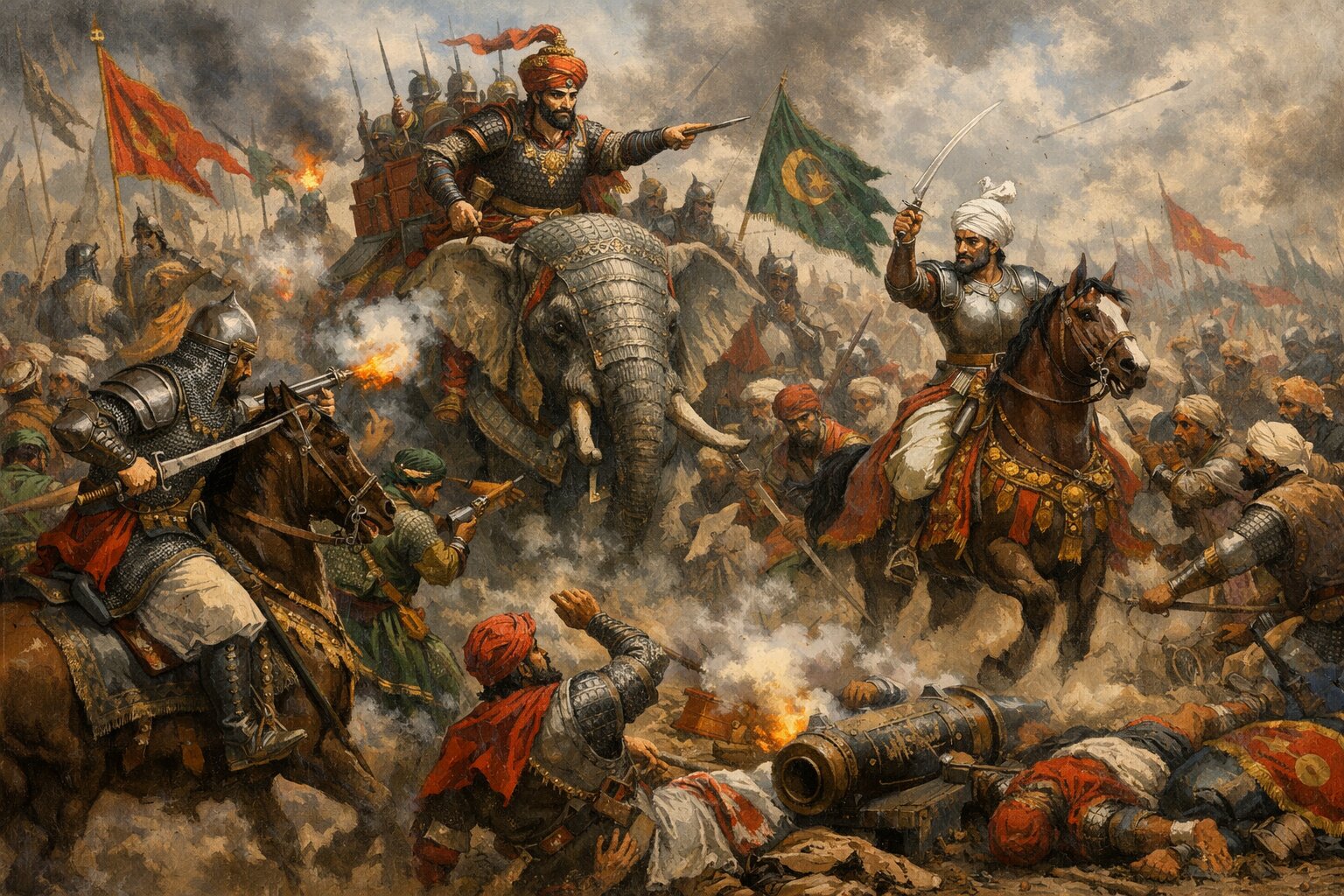
- Event Battle of Khanwa
- Date 16 March 1527
- Location Khanwa near Fatehpur Sikri, Rajasthan
- Combatants Mughal Empire vs Rajput Confederacy
- Mughal Leader Babur
- Rajput Leader Rana Sanga of Mewar
- Outcome Decisive Mughal Victory
A Clash That Shaped Indian History
On 16 March 1527, the dusty plains near the small village of Khanwa became the stage for one of the most dramatic battles in Indian medieval history. Two powerful forces prepared for a confrontation that would determine the future political direction of northern India.
On one side stood Babur, the ambitious Central Asian ruler who had recently captured Delhi after defeating the Lodi Sultanate at the First Battle of Panipat in 1526. On the other side stood Rana Sanga, the formidable ruler of Mewar and leader of a powerful Rajput confederacy determined to stop Mughal expansion into India.
The confrontation between these two leaders was not merely a regional struggle for power. It was a decisive test of military systems, leadership, and the future balance of power in the subcontinent.
The Rise of Babur
Zahir-ud-din Muhammad Babur was a descendant of both Timur and Genghis Khan. Born in 1483 in the Fergana Valley of Central Asia, Babur spent much of his early life fighting to secure territory and establish his authority. After years of struggle in Central Asia, he turned his attention toward the rich and politically fragmented lands of northern India.
Babur's victory at Panipat gave him control of Delhi and Agra, but the situation remained unstable. Many regional rulers refused to accept Mughal authority. Among them, Rana Sanga emerged as the strongest and most determined challenger.
The Power of Rana Sanga
Rana Sangram Singh, widely known as Rana Sanga, was one of the most powerful Rajput rulers of the early sixteenth century. As the ruler of Mewar, he had expanded his influence across Rajasthan and parts of central India, defeating several neighboring powers.
Rana Sanga believed that Babur, like earlier Central Asian invaders, would eventually withdraw from India. Instead of retreating, Babur began consolidating power, prompting Rana Sanga to assemble a vast coalition of Rajput rulers and Afghan nobles who opposed Mughal rule.
The Rajput Confederacy
The Rajput confederacy was an impressive alliance of warrior states. It included several Rajput kingdoms and Afghan chiefs who had lost influence after the fall of the Lodi dynasty. Their combined forces created one of the largest armies seen in northern India at the time.
Rajput warriors were famous for their bravery and fierce cavalry charges. They relied heavily on traditional combat techniques involving swords, spears, and armored horsemen.
Mughal Military Innovations
Babur, however, brought something new to Indian warfare. His army used gunpowder technology, including artillery cannons and matchlock firearms. These weapons had already transformed warfare in parts of the Middle East and Central Asia but were still relatively new on the Indian battlefield.
Babur also adopted advanced tactics learned from the Ottomans. One of the most effective was the tulughma formation, which divided the army into mobile flanking units capable of surrounding the enemy. Defensive wagon barriers protected the artillery and allowed Mughal gunners to fire safely at approaching forces.
The Battle Begins
As the battle began, the Rajput forces launched aggressive attacks against Babur's positions. Their powerful cavalry charges attempted to break through Mughal defenses and overwhelm the smaller Mughal army.
For a moment the outcome seemed uncertain. The Rajput warriors fought with extraordinary courage and determination, pressing forward despite heavy resistance.
But Babur's artillery began to change the course of the battle. Cannon fire and gunshots disrupted the Rajput formations and inflicted heavy casualties among the charging troops.
The Turning Point
The decisive moment came when Babur deployed the tulughma tactic. His cavalry units moved around the flanks of the Rajput army, attacking from the sides and rear. This maneuver caused confusion and weakened the coordination of the Rajput forces.
During the fighting, Rana Sanga was reportedly wounded and removed from the battlefield by his supporters. Without their leader directing the battle, the Rajput army began to lose cohesion.
Victory for Babur
As Mughal artillery continued firing and cavalry units surrounded the Rajput formations, the tide of battle turned decisively in Babur's favor. Eventually the Rajput confederacy was forced to retreat from the battlefield.
The victory was a major triumph for Babur. It demonstrated the effectiveness of gunpowder weapons and disciplined battlefield tactics against traditional cavalry-based armies.
Aftermath and Legacy
The Battle of Khanwa proved to be one of the most important turning points in Indian history. By defeating the Rajput confederacy, Babur secured his control over northern India and ensured the survival of the Mughal regime.
Although Rajput resistance continued in later years, no coalition of similar strength would challenge Babur again during his reign.
The Mughal Empire that Babur established would later be expanded and strengthened by his successors, particularly his grandson Akbar. Over the next two centuries, the Mughal Empire would become one of the most powerful and culturally influential states in the world.
The Battle of Khanwa therefore stands as a moment when the course of Indian history shifted dramatically — a clash of armies that helped shape the political future of an entire subcontinent.
Frequently Asked Questions
When was the Battle of Khanwa fought?
The Battle of Khanwa was fought on 16 March 1527 between the Mughal emperor Babur and the Rajput confederacy led by Rana Sanga of Mewar.
Where did the Battle of Khanwa take place?
The battle took place at Khanwa, a village near Fatehpur Sikri in present-day Rajasthan, India.
Who fought in the Battle of Khanwa?
The battle was fought between the Mughal Empire led by Babur and a powerful Rajput confederacy led by Rana Sanga, supported by several Afghan chiefs.
Who won the Battle of Khanwa?
The Mughal emperor Babur won the battle after defeating the Rajput confederacy and its allies.
Why is the Battle of Khanwa important in Indian history?
The victory secured Babur's control over northern India and played a crucial role in establishing the Mughal Empire in the Indian subcontinent.
How large were the armies at the Battle of Khanwa?
Historical estimates suggest that Babur commanded around 20,000–25,000 troops, while Rana Sanga's Rajput confederacy may have had 70,000–80,000 soldiers.
What weapons and tactics helped Babur win the battle?
Babur used field artillery, matchlock firearms, defensive wagon formations, and the tulughma flanking tactic, which proved decisive against traditional Rajput cavalry charges.
What happened to Rana Sanga after the battle?
Rana Sanga was seriously wounded during the battle and removed from the battlefield by his followers. The Rajput army eventually retreated.
Did the Battle of Khanwa end Rajput resistance?
No. Although the battle weakened the Rajput confederacy, Rajput kingdoms continued to resist Mughal expansion in later decades.