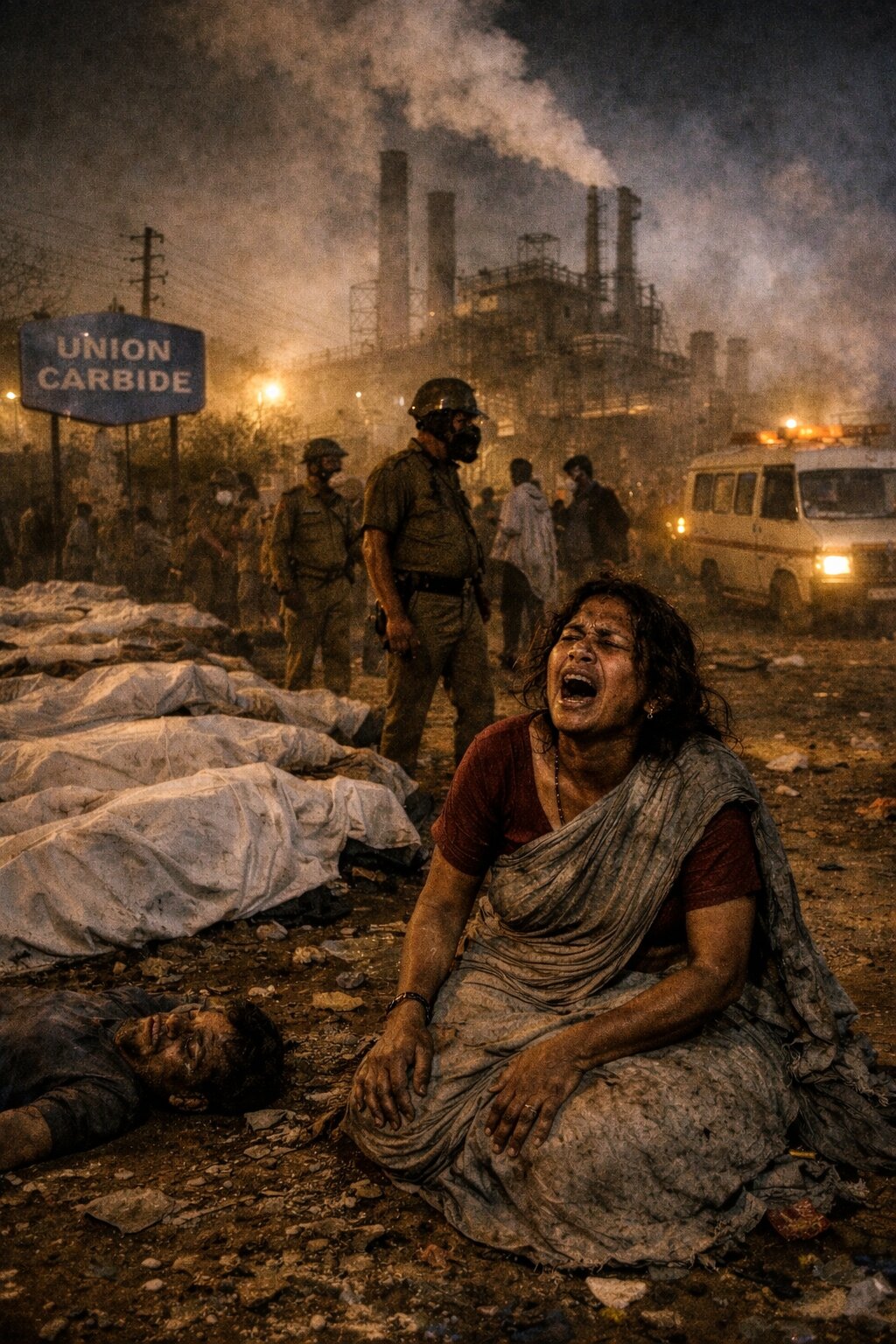
- Event Bhopal Gas Tragedy — catastrophic methyl isocyanate leak from UCIL plant
- Date Night of 2–3 December 1984
- Location Union Carbide India Limited plant, Bhopal, Madhya Pradesh, India
- Gas Leaked Methyl Isocyanate (MIC) — approximately 40 tonnes
- Deaths (Official) 3,787 confirmed by Government of Madhya Pradesh; 5,295 per Government of India affidavit (2006)
- Injured / Affected Approximately 5.74 lakh (574,000) registered gas-affected victims
- Compensation Settled USD 470 million — Supreme Court of India approved settlement, February 1989
- Conviction 7 former UCIL employees convicted on 7 June 2010 under IPC Section 304-A
- Classification Worst industrial disaster in recorded history
The Plant and the Night of 2 December 1984
The Union Carbide India Limited (UCIL) pesticide manufacturing plant in Bhopal had been operational since 1969. It was established as a joint venture between Union Carbide Corporation (UCC) of the United States, which held a 50.9% stake, and Indian public and private investors. The plant manufactured the pesticide Sevin (carbaryl) and stored large quantities of methyl isocyanate (MIC), a highly reactive and toxic intermediate chemical, in underground storage tanks on site.
By the early 1980s, the plant had scaled back production due to declining pesticide demand, and several safety systems had been taken offline or were non-functional. The plant was located adjacent to densely populated neighbourhoods — Jayaprakash Nagar, Kazi Camp, Chola Kenchi, and others — whose residents had grown up around the factory without awareness of the toxicity of its stored chemicals.
Shortly after midnight on 3 December 1984, a runaway reaction inside Tank E610 caused a catastrophic release of MIC gas and reaction by-products through a pressure relief valve into the atmosphere. The gas, being approximately twice as dense as air, did not disperse upward — it settled at ground level and drifted with the wind across the surrounding residential areas. Residents awoke to severe burning in their eyes, throats, and lungs. Thousands died in their homes, in the streets, and while attempting to flee.
The Scale of Death and Injury — Official Figures
The official death toll from the Bhopal Gas Tragedy has been a subject of varying government figures over the decades. The established official records are as follows:
- The Government of Madhya Pradesh officially confirmed 3,787 deaths directly caused by the gas leak in its records
- The Government of India, in an affidavit submitted to the Supreme Court of India in 2006, stated the disaster caused approximately 5,295 deaths
- Approximately 5.74 lakh (574,000) people were registered as gas-affected victims with the Bhopal Gas Tragedy Relief and Rehabilitation Department
- The government classified 1,03,217 people as having permanent partial disability
- A further 3,900 people were classified as severely and permanently disabled
The gas caused severe damage to the eyes, lungs, and neurological systems of those exposed. The most common causes of death in the immediate aftermath were pulmonary oedema (fluid in the lungs) and respiratory failure. Long-term health effects documented in government health surveys include chronic respiratory disease, neurological damage, vision impairment, and increased rates of certain cancers among the affected population.
The Immediate Government Response
The Government of Madhya Pradesh declared a state of emergency in Bhopal on 3 December 1984. The plant was sealed and Union Carbide India Limited's operations were halted immediately. The Chief Minister of Madhya Pradesh, Arjun Singh, visited the affected areas on the morning of 3 December.
Warren Anderson, the Chairman of Union Carbide Corporation, flew to Bhopal on 7 December 1984. He was arrested by Madhya Pradesh police upon arrival, charged under sections of the Indian Penal Code, released on bail of ₹25,000, and subsequently left India. He was later declared a fugitive from justice by a Bhopal court in 1992 after he failed to appear before the court. He died in the United States in 2014 without having faced trial in India.
The Legal Settlement — USD 470 Million
The Government of India filed suit against Union Carbide Corporation in the United States District Court for the Southern District of New York in 1985. The case was subsequently transferred to India by the US court. Litigation continued in Indian courts through the late 1980s.
On 14–15 February 1989, the Supreme Court of India approved a full and final settlement between the Government of India and Union Carbide Corporation for USD 470 million (approximately ₹715 crore at the prevailing exchange rate). The settlement was presented as covering all civil and criminal claims arising from the disaster.
Key details of the settlement as established in official records:
- The USD 470 million was paid in full by Union Carbide Corporation
- The funds were administered by the Bhopal Gas Tragedy Relief and Rehabilitation Department of the Government of Madhya Pradesh
- A total of ₹1,546.37 crore was ultimately distributed among registered gas-affected victims
- The Supreme Court quashed all criminal proceedings against Union Carbide as part of the settlement — a decision it later partially reversed in 1991 upon review petitions
Criminal Proceedings and the 2010 Verdict
Criminal cases against former officials of Union Carbide India Limited proceeded separately through Bhopal's district courts for over two decades. On 7 June 2010, the Chief Judicial Magistrate's Court in Bhopal delivered its verdict in the criminal case.
Seven former Indian employees of UCIL were convicted under Section 304-A of the Indian Penal Code (causing death by negligence). The convicted individuals included:
- Keshub Mahindra — former Non-Executive Chairman of UCIL
- V. P. Gokhale — former Managing Director of UCIL
- Kishore Kamdar — former Vice President of UCIL
- J. Mukund — former Works Manager
- S. P. Chowdhury — former Production Manager
- K. V. Shetty — former Plant Superintendent
- S. I. Qureshi — former Production Assistant
Each was sentenced to two years imprisonment and fined ₹1 lakh — the maximum punishment available under Section 304-A at the time. All seven were granted bail by the sessions court within hours of the verdict.
The Plant Site — Contamination and Remediation
The UCIL plant was shut down immediately after the disaster and has never resumed operations. The Government of Madhya Pradesh took possession of the site. The plant buildings and equipment remain largely as they were abandoned.
Government surveys and court-ordered investigations have established that soil and groundwater contamination around the plant site persists. The Supreme Court of India has issued multiple directions regarding remediation of the site. The Madhya Pradesh government has undertaken soil removal and containment operations in phases, though the remediation has been subject to ongoing litigation regarding its adequacy.
In 2004, the Supreme Court of India directed the Madhya Pradesh government to supply clean drinking water to residents in areas around the plant site where groundwater contamination had been detected. This order has been the subject of compliance monitoring by the court in subsequent years.
Why 3 December 1984 Remains a Defining Date
The Bhopal Gas Tragedy is officially classified as the worst industrial disaster in recorded history — a classification that has not been disputed in any official government or international body's assessment in the four decades since.
Its significance extends across four dimensions that remain live issues in Indian law and policy:
- Industrial Safety Regulation: The disaster directly led to the enactment of the Environment Protection Act, 1986 and the Public Liability Insurance Act, 1991 in India — establishing for the first time a statutory framework for industrial hazard liability and compulsory insurance for hazardous industries
- Corporate Accountability: The failure to extradite Warren Anderson and the perceived inadequacy of the USD 470 million settlement relative to the scale of harm became reference points in international debates on multinational corporate liability in developing nations
- Victim Rehabilitation: The Bhopal Gas Tragedy Relief and Rehabilitation Department of the Government of Madhya Pradesh continues to function, administering ongoing medical and welfare programmes for registered gas-affected survivors and their families
- Site Remediation: The contamination of the plant site and surrounding groundwater remains an active matter before the Supreme Court of India, with the question of liability for full remediation costs unresolved as of the most recent court proceedings
Frequently Asked Questions
When did the Bhopal Gas Tragedy occur?
The Bhopal Gas Tragedy occurred on the night of 2–3 December 1984. The leak of methyl isocyanate (MIC) gas from the Union Carbide India Limited (UCIL) plant began shortly after midnight and spread rapidly across densely populated neighbourhoods of Bhopal, Madhya Pradesh.
What gas leaked in the Bhopal disaster?
The primary gas that leaked was methyl isocyanate (MIC), a highly toxic chemical used in the manufacture of the pesticide Sevin (carbaryl). Approximately 40 tonnes of MIC escaped from Tank 610 of the UCIL plant. The gas, being denser than air, settled at ground level and spread into surrounding residential areas.
How many people died in the Bhopal Gas Tragedy?
The Government of Madhya Pradesh officially confirmed 3,787 deaths directly attributable to the gas leak. However, the Indian government's affidavit submitted to the Supreme Court of India in 2006 stated that the disaster killed approximately 5,295 people. Various government estimates over the years have ranged between these figures.
How many people were affected by the Bhopal Gas Tragedy?
According to official Indian government records, approximately 5.74 lakh (574,000) people were registered as gas-affected victims. Of these, the government classified 1,03,217 people as having permanent partial disability and 3,900 as severely and permanently disabled. Over 5 lakh people were exposed to the toxic gas.
What was the compensation paid to Bhopal victims?
In February 1989, the Supreme Court of India approved a settlement between the Government of India and Union Carbide Corporation for USD 470 million (approximately ₹715 crore at the time). This settlement was made in full and final settlement of all claims arising from the disaster. The compensation was distributed to victims through the Bhopal Gas Tragedy Relief and Rehabilitation Department of the Government of Madhya Pradesh.
Who was convicted in the Bhopal Gas Tragedy case?
On 7 June 2010, a Bhopal court convicted seven former Indian employees of Union Carbide India Limited, including former UCIL chairman Keshub Mahindra, under Section 304-A of the Indian Penal Code (causing death by negligence). Each was sentenced to two years imprisonment and fined ₹1 lakh. All were granted bail shortly after the verdict. Warren Anderson, the American chairman of Union Carbide Corporation, was declared a fugitive from justice by an Indian court but was never extradited.
What happened to the Union Carbide plant after the disaster?
The UCIL plant was shut down immediately after the disaster. In 1994, Union Carbide Corporation sold its stake in UCIL to McLeod Russel (India) Ltd. The site was later acquired by the Government of Madhya Pradesh. The plant has remained abandoned. The contamination of soil and groundwater around the plant site has been an ongoing concern, with the Supreme Court of India directing remediation efforts. The Madhya Pradesh government has undertaken partial cleanup operations.
What is the current status of Bhopal gas victim compensation and rehabilitation?
As of the last official government data, the Bhopal Gas Tragedy Relief and Rehabilitation Department of the Government of Madhya Pradesh continues to administer relief. A total of ₹1,546.37 crore was distributed among gas victims from the USD 470 million settlement fund. The Government of India filed a curative petition in the Supreme Court in 2010 seeking additional compensation of USD 7.844 billion from Union Carbide's successor Dow Chemical, which remains under judicial consideration.