- Event: World's First Powered, Sustained & Controlled Airplane Flight
- Date: 17 December 1903
- Location: Kill Devil Hills, Kitty Hawk, North Carolina, USA
- Pilot (Flight 1): Orville Wright
- Flight 1 Duration: 12 seconds
- Flight 1 Distance: 120 feet (37 m)
- Longest Flight (Flight 4): 59 seconds — 852 feet (260 m) — piloted by Wilbur Wright
- Aircraft: Wright Flyer (Flyer I)
- Engine: 12 HP, 4-cylinder, home-built
- Wingspan: 40 ft 4 in (12.3 m)
- Aircraft Weight: 605 lbs (274 kg)
- Witnesses: 5 people present — including John T. Daniels who took the famous photograph
- Historic: First heavier-than-air powered flight in recorded history
- Aircraft Today: Smithsonian National Air and Space Museum, Washington D.C.
Sixty-six years after Orville Wright's 12-second hop across the sand at Kill Devil Hills, Neil Armstrong walked on the Moon. That staggering arc of progress — from a fragile wooden biplane to a Saturn V rocket — began on a cold Thursday morning in December 1903, in front of just five witnesses, with a machine powered by an engine the brothers had built themselves in the back of their bicycle shop.
The Brothers Who Defied Gravity
Wilbur Wright (1867–1912) and Orville Wright (1871–1948) grew up in Dayton, Ohio, the sons of a bishop. Neither completed high school. Neither attended university. They had no formal engineering training and no government money. What they had was a bicycle shop, a mechanical genius for understanding forces and balance, and an obsession with a problem that had defeated funded scientists, military engineers, and professional inventors for decades.
Their insight was profound and simple: the problem of flight was not power — it was control. Other inventors built engines and launched themselves into the air. The Wright Brothers asked a different question: once you are in the air, how do you stay there and go where you want?
Years of Preparation — Gliders and Wind Tunnels
The 1903 flight did not come from nowhere. The brothers spent four years of systematic experimentation before Kitty Hawk. In 1900 and 1901 they tested gliders at Kill Devil Hills, accumulating more hours of glider flight than any human being before them. When their real-world results disagreed with accepted aeronautical data, they did something radical — they built their own wind tunnel.
In the winter of 1901–1902, the brothers tested over 200 different wing shapes in their homemade wind tunnel — a six-foot wooden box with a fan at one end — systematically measuring lift and drag. Their data was more accurate than anything previously published. This tunnel work gave them the wing shape — and the critical discovery of wing warping for roll control — that made the Flyer possible.
- 1899: Wilbur writes to the Smithsonian Institution requesting all publications on flight
- 1900: First glider tests at Kitty Hawk — 17 flights, max 300 ft
- 1901: Larger glider — results disappointing, disagreed with Lilienthal's data
- 1901–02: Wind tunnel built in Dayton — 200+ wing shapes tested
- 1902: New glider with moveable rudder — nearly 1,000 successful glides
- 1903: Build the powered Flyer — design their own engine and propellers
Building the Wright Flyer
The Wright Flyer was a biplane — two wings stacked one above the other — constructed from spruce and ash wood, covered in Pride of the West muslin fabric, braced with steel wire. Its design incorporated every lesson from four years of glider experiments. The pilot lay face down on the lower wing — not seated — to reduce drag.
When no engine manufacturer could supply a lightweight enough motor, the brothers designed and built their own. Their mechanic, Charles Taylor, machined it from scratch in just six weeks. It produced 12 horsepower and weighed only 180 pounds (82 kg) — an extraordinary power-to-weight ratio for 1903. They also designed their own propellers, applying wing theory to create efficient wooden blades — a solution no one had attempted before.
- Wingspan: 40 ft 4 in (12.3 m)
- Length: 21 ft 1 in (6.4 m)
- Weight (with pilot): ~750 lbs (340 kg)
- Engine: 4-cylinder, water-cooled, 12 HP
- Top speed: ~30 mph (48 km/h)
- Construction time: Built by hand in Dayton, assembled at Kill Devil Hills
17 December 1903 — The Morning That Changed Everything
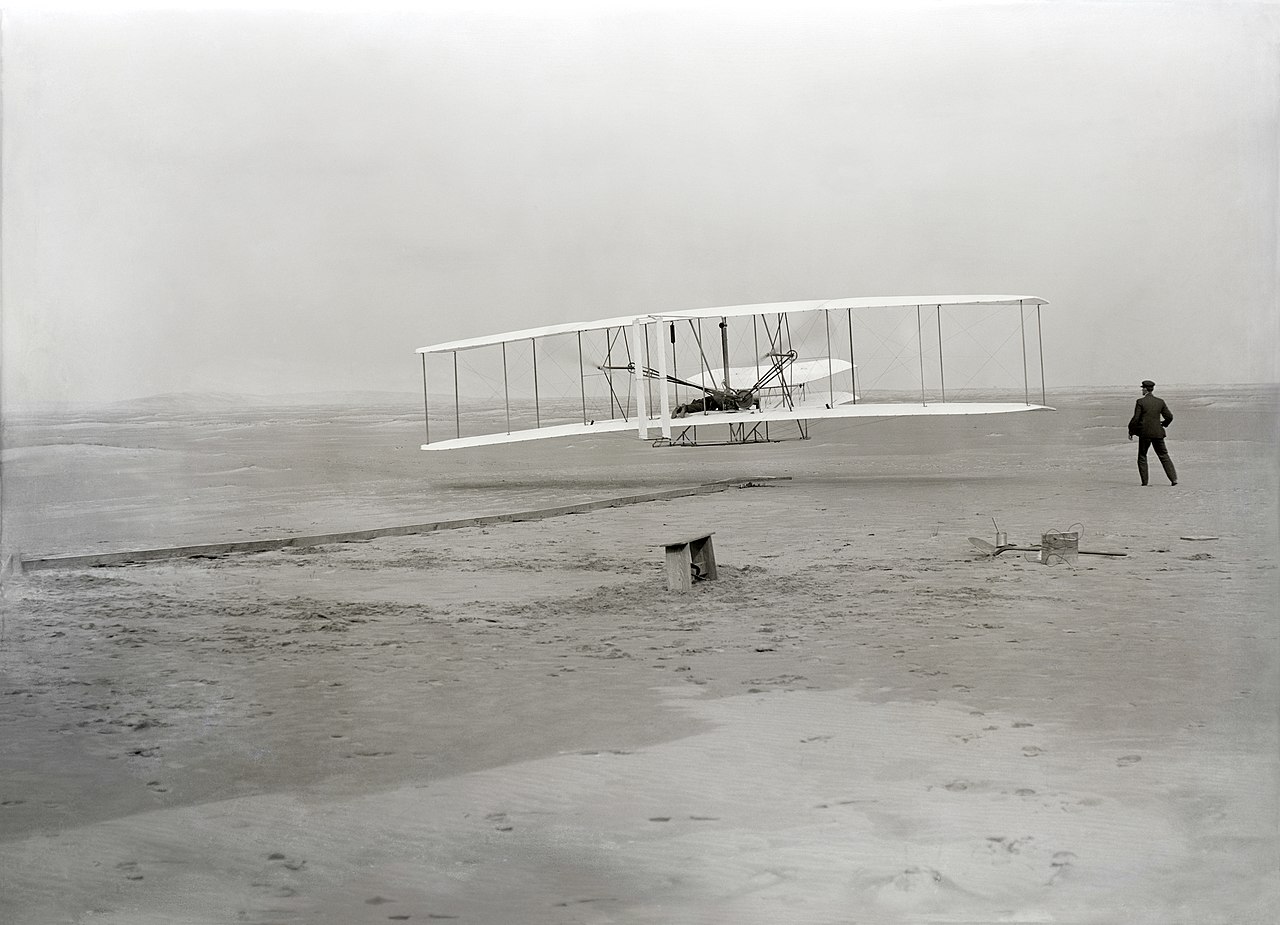
The morning of 17 December 1903 was bitterly cold — temperatures hovering near freezing, with a 27 mph wind off the Atlantic. The brothers had already suffered weeks of delays — mechanical failures, a cracked propeller shaft, a broken engine component that required a trip back to Dayton. Now, finally, everything was ready.
Five witnesses gathered at Kill Devil Hills: three men from the nearby Kill Devil Hills Life Saving Station, a local farmer, and a teenage boy. One of those witnesses, John T. Daniels — a surfman who had never operated a camera before — was handed Orville's pre-positioned camera and told to squeeze the bulb if the machine left the ground. The photograph he took at 10:35 a.m. became one of the most reproduced images in history.
The Four Flights
On that cold December morning, the Wright Brothers did not make just one flight. They made four — each one longer than the last, taking turns at the controls as they gained confidence with the Flyer's handling.
- Flight 1 — Orville Wright: 12 seconds · 120 feet (37 m) — 10:35 a.m.
- Flight 2 — Wilbur Wright: 12 seconds · 175 feet (53 m)
- Flight 3 — Orville Wright: 15 seconds · 200 feet (61 m)
- Flight 4 — Wilbur Wright: 59 seconds · 852 feet (260 m) — the longest of the day
After the fourth flight, a sudden gust of wind caught the Flyer and flipped it, causing damage too severe to repair on-site. The aircraft never flew again. But it had already done everything it needed to do. The brothers sent a telegram to their father that evening: Success four flights Thursday morning all against twenty-one mile wind started from level with engine power alone average speed through air thirty-one miles longest 57 seconds inform press home Christmas.
Why This Flight — and Not Others?
Several rivals were close. Samuel Langley, Secretary of the Smithsonian and backed by $70,000 in U.S. government funding, launched his Aerodrome just nine days before the Wright Brothers flew — and crashed it into the Potomac River twice. Octave Chanute, Otto Lilienthal, and Percy Pilcher all contributed knowledge but none achieved controlled powered flight. The Wright Brothers succeeded because they solved all three requirements simultaneously: power, lift, and control.
- Lift: Wind tunnel data gave them superior wing design — more efficient than anything previously built
- Power: Custom-built 12 HP engine light enough not to overwhelm the wings
- Control: Three-axis control system — wing warping (roll), forward elevator (pitch), moveable rudder (yaw) — the first complete solution to flight control
The World Barely Noticed
Remarkably, the world did not immediately understand what had happened at Kill Devil Hills. The brothers sent a press release. Most newspapers ignored it or printed garbled versions with wildly inaccurate details. The Dayton Daily News refused to publish the story. Some reports claimed the flight lasted three miles. It would take years before the significance of 17 December 1903 was widely understood.
The brothers, wary of competitors stealing their designs, were deliberately secretive for the next two years — refusing to fly publicly until their patent was secure. It was only in 1908, when Wilbur flew in Le Mans, France before crowds of thousands, that the world finally grasped what the Wright Brothers had achieved. European aviation pioneers who had claimed to surpass them fell silent when they saw the Flyer's three-axis control system in action.
Legacy — From 12 Seconds to the Moon
The distance of Wilbur Wright's longest flight on 17 December 1903 — 852 feet — is shorter than the wingspan of a modern Boeing 747. Within 11 years, aircraft were fighting dogfights over the trenches of World War I. Within 24 years, Lindbergh crossed the Atlantic solo. Within 45 years, Chuck Yeager broke the sound barrier. Within 66 years, humans stood on the Moon.
- 1903: First flight — 12 seconds, 120 feet
- 1908: Wilbur flies 91 minutes in France — aviation becomes undeniable
- 1914–18: World War I — aircraft used for reconnaissance and combat for the first time
- 1927: Lindbergh flies New York to Paris non-stop — 33.5 hours
- 1947: Chuck Yeager breaks the sound barrier in the Bell X-1
- 1969: Apollo 11 — humans land on the Moon, 66 years after Kitty Hawk
- 2003: Centenary of flight — over 3 billion air passengers fly annually
- 2021: NASA's Ingenuity helicopter makes the first powered flight on another planet — on Mars — and carries a piece of fabric from the original Wright Flyer
The Wright Flyer itself survived. After the 1903 flights damaged it beyond further use, it was stored, loaned to a museum in England for years, and finally installed in the Smithsonian National Air and Space Museum in Washington D.C., where it remains today — suspended from the ceiling in the Milestones of Flight gallery, 120 feet of wood and fabric that carry the weight of everything that came after.
Frequently Asked Questions
Who made the first airplane flight in history?
Orville Wright piloted the world's first successful powered, sustained, and controlled airplane flight on 17 December 1903 at Kill Devil Hills, near Kitty Hawk, North Carolina. His brother Wilbur Wright watched from the ground. Together, they designed, built, and flew the Wright Flyer — the aircraft that made it possible.
When and where was the first airplane flight?
The first flight took place on 17 December 1903 at Kill Devil Hills, near Kitty Hawk, North Carolina, USA. The Wright Brothers made four flights that day. The first lasted 12 seconds and covered 120 feet (37 metres). The longest flight of the day lasted 59 seconds and covered 852 feet (260 metres).
How long was the Wright Brothers' first flight?
The very first flight, piloted by Orville Wright, lasted 12 seconds and covered 120 feet (about 37 metres). Later that same morning, Wilbur Wright flew the fourth and longest flight — 59 seconds in the air covering 852 feet (260 metres) before a gust of wind damaged the Flyer on landing.
What was the Wright Flyer?
The Wright Flyer (also called Flyer I) was the world's first successful powered aircraft. It was a biplane built from spruce wood, muslin fabric, and wire, weighing 605 pounds (274 kg) with a 12-horsepower, 4-cylinder engine the brothers designed themselves. Its wingspan was 40 feet 4 inches (12.3 metres). The original Flyer is preserved at the Smithsonian National Air and Space Museum in Washington, D.C.
Who were the Wright Brothers?
Orville Wright (1871–1948) and Wilbur Wright (1867–1912) were American inventors and aviation pioneers from Dayton, Ohio. They owned a bicycle repair and manufacturing shop, which gave them the mechanical skills and engineering intuition to solve the problem of controlled powered flight. They had no university education and no government funding — just relentless experimentation.
Why did the Wright Brothers choose Kitty Hawk?
The Wright Brothers chose the Kitty Hawk area on the Outer Banks of North Carolina for three key reasons: it had consistent, strong winds ideal for testing gliders; soft sandy ground for safer crash landings; and it was remote enough to allow private experimentation away from competitors and the press. They first contacted the U.S. Weather Bureau to identify the windiest locations in the country.
Did anyone else claim to fly before the Wright Brothers?
Several claimants exist — most notably Gustave Whitehead, who some claim flew a powered aircraft in Connecticut in 1901. However, the Wright Brothers' 1903 flight remains the universally accepted first because it was powered, sustained, controlled, and independently witnessed. The Smithsonian Institution and the international aviation community recognise Kitty Hawk as the birthplace of powered flight.
What happened after the first flight?
After the flights of 17 December 1903, the Wright Brothers continued refining their designs. By 1905, their Wright Flyer III could fly for over 30 minutes in controlled circles. In 1908, Wilbur flew in France, astonishing European audiences. The brothers patented their flying machine and eventually formed the Wright Company in 1909. Aviation transformed warfare in World War I just 11 years after that first 12-second hop.